
Trello
Virality

Helping to turbo-charge collaboration
for Trello users
- UX Strategy
- Research
- Experiments
- Interaction Design
- Visual Design
- QA & Impact
Growth TEAM
- Senior Product Designer (me)
- Product Manager
- Senior Data Analyst
- Engineer Manager
- Content Designer
- 14 Engineers
Platform
Trello responsive website
Timeline
Nov – June 2021
My role
I led UX strategy and end-to-end design process
As a Growth Designer, I led virality initiatives for Trello using data-driven strategies. My role included user needs research, guiding teams to establish requirements, and creating iterative designs. I worked to optimize the customer funnel through acquisition, activation, retention, and monetization, aiming to boost Trello’s success.
For the purpose of this case study, I will give an overview of the UX strategy, and unsuccessful experiments, and dive deep into the “Workspace share link” experiment that increased retention.
Atlassian’s mission

Unleashing the Potential of Every Team
Atlassian, an esteemed Australian software company has a clear commitment to unlocking the potential of all teams. Atlassian’s portfolio, which includes notable software such as Jira, Confluence, and Trello, is geared towards facilitating effective collaboration among diverse team members – be it software developers, project managers, or other professionals.
Particularly, Trello stands out as an intuitive and versatile visual project management tool. It provides a flexible workspace that empowers teams to manage tasks, monitor progress, and refine workflows to boost productivity.

…with Trello Virality
Atlassian’s leaders had the vision to grow Trello and make it even better for users by unblocking collaboration. So the Trello Virality FY22 Initiative was born and aimed to focus on improving how Trello users work together, and how they invite others to Trello to collaborate.
The goal was to turbocharger collaboration and make Trello a go-to tool for all teams, no matter their size or field.
Trello, among other Atlassian products, had the biggest churn rate. Additionally, the Atlassian leadership wanted to increase OKRs, MAU, and revenue within one year of running the growth experiments.
Problem
What were the main challenges?
Solution
Optimizing and innovating collaboration journeys with 7 experiments
The objective was to focus on the invitation to collaborate experience, validate the hypothesis, run the following experiments and productionize the ones with statistically significant MAU:
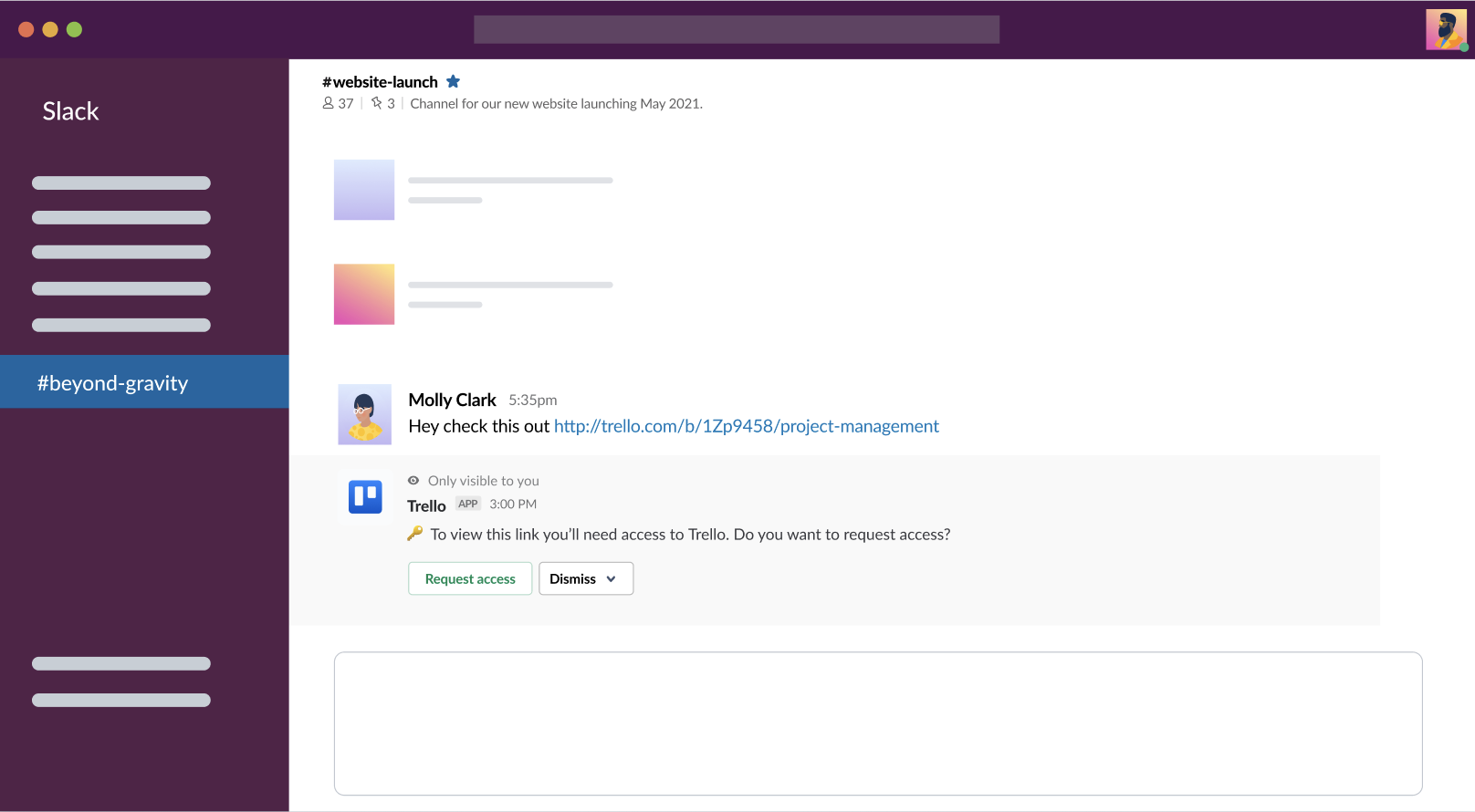
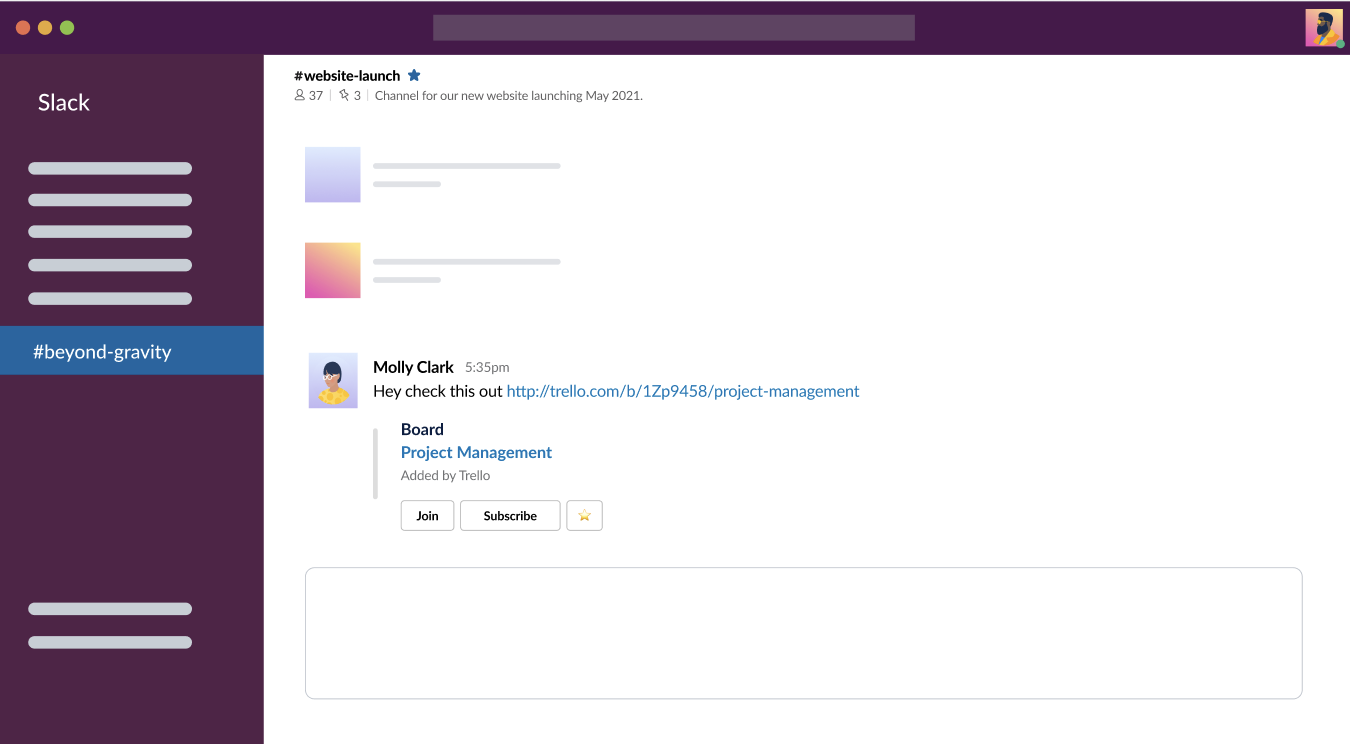
- Request Access When Blocked (Phases 1,2 & 3)
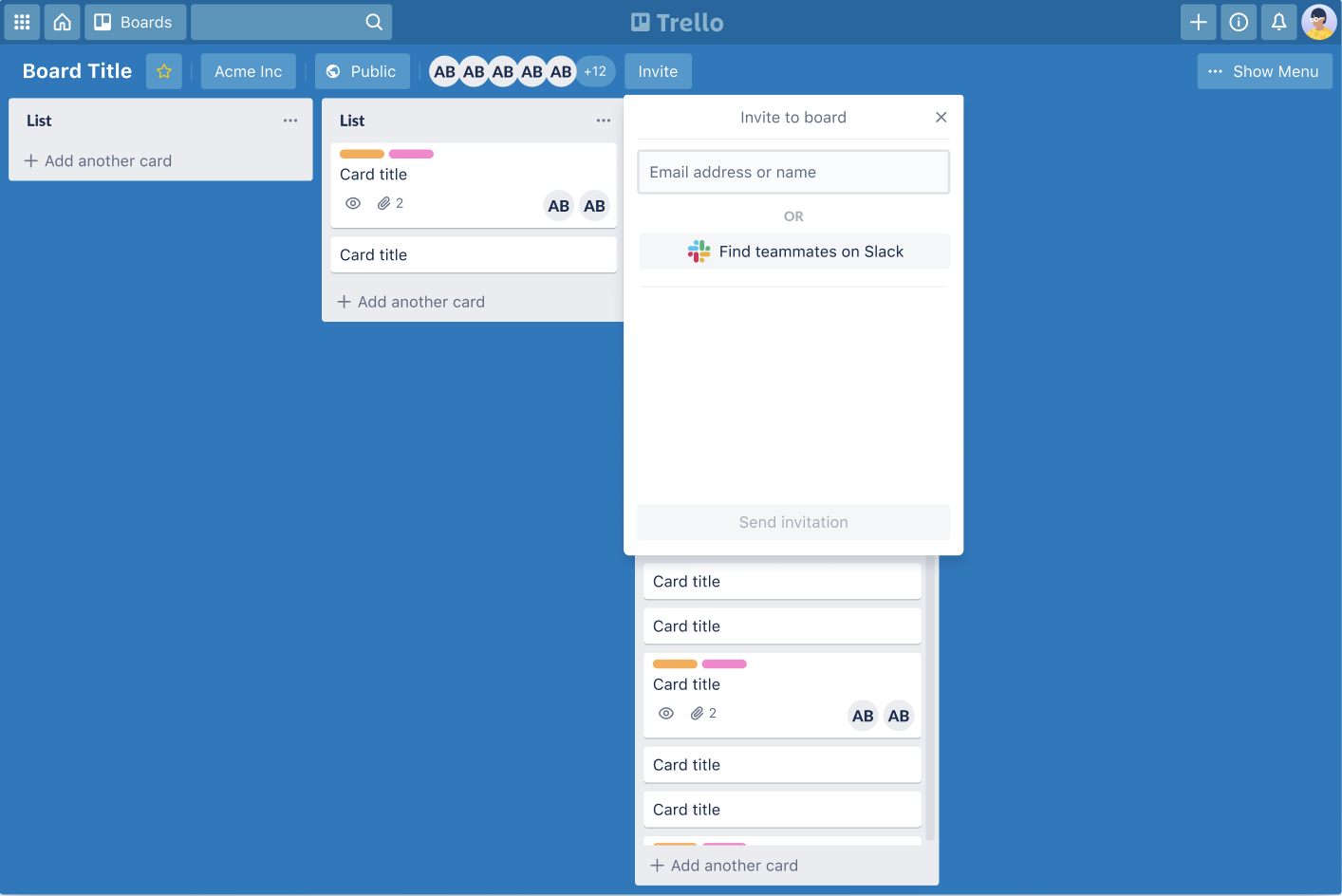
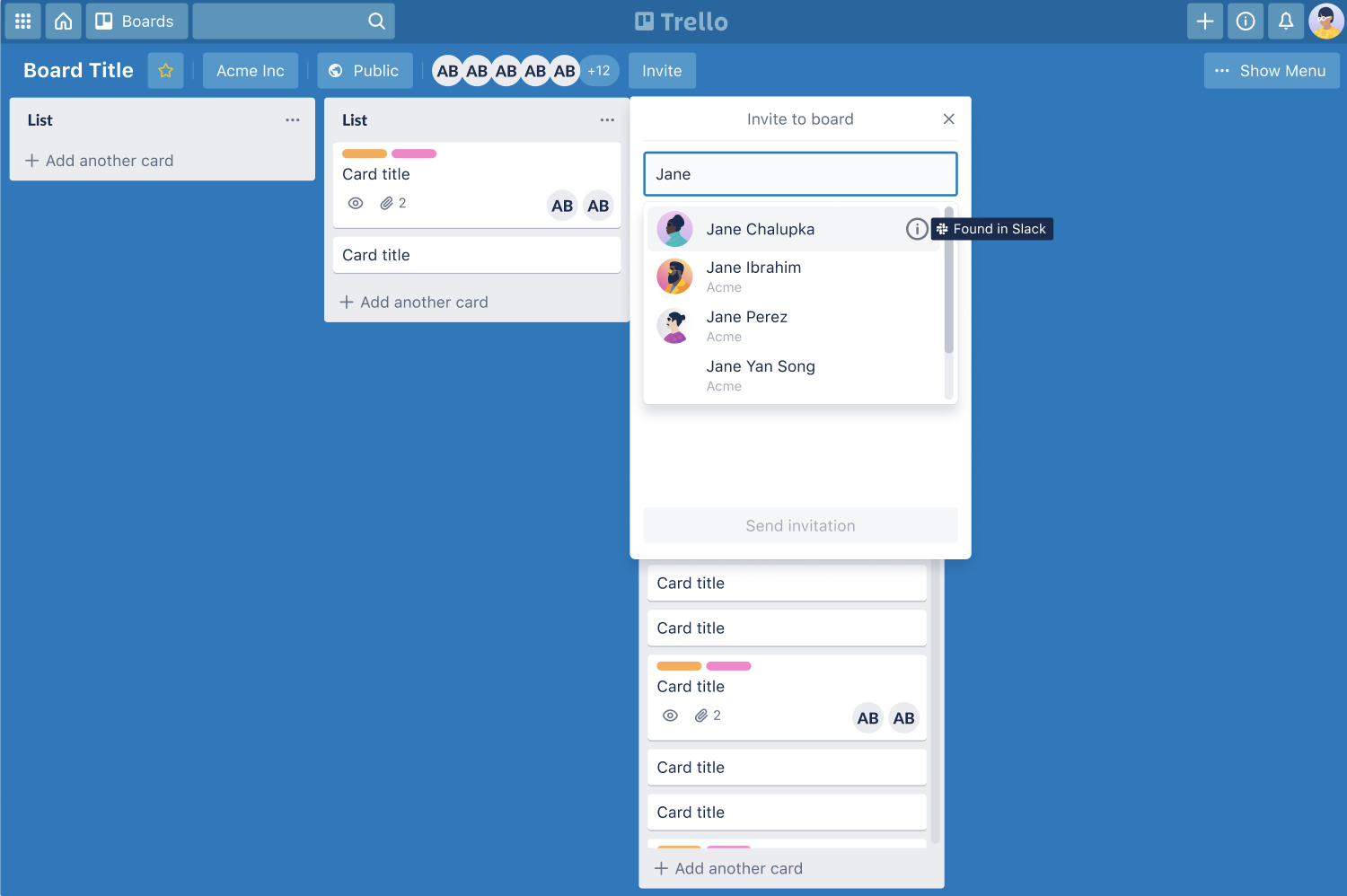
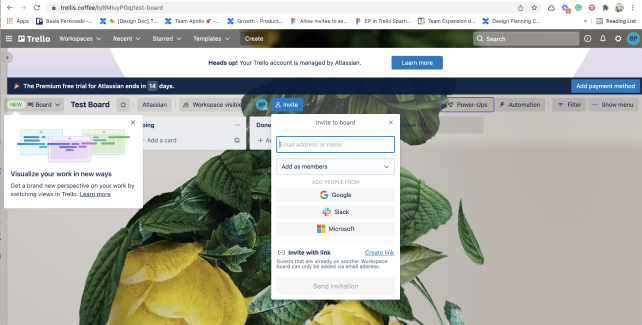
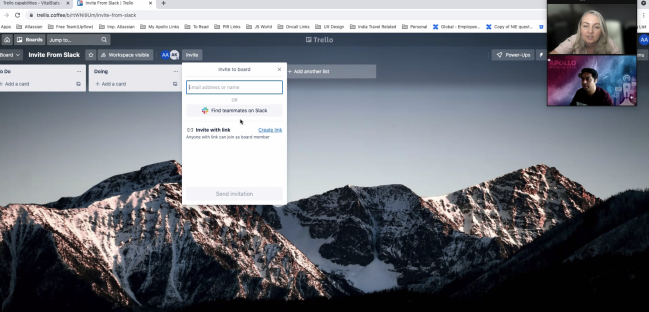
- Invite from Slack
- Invite from Google
- Invite from Microsoft Teams
- Invite to a Workspace via link/email
- Invite to a Board via link/email
I led seven experiments, including the “Workspace share link” experiment, which notably brought in 3,000 additional monthly users to Trello.
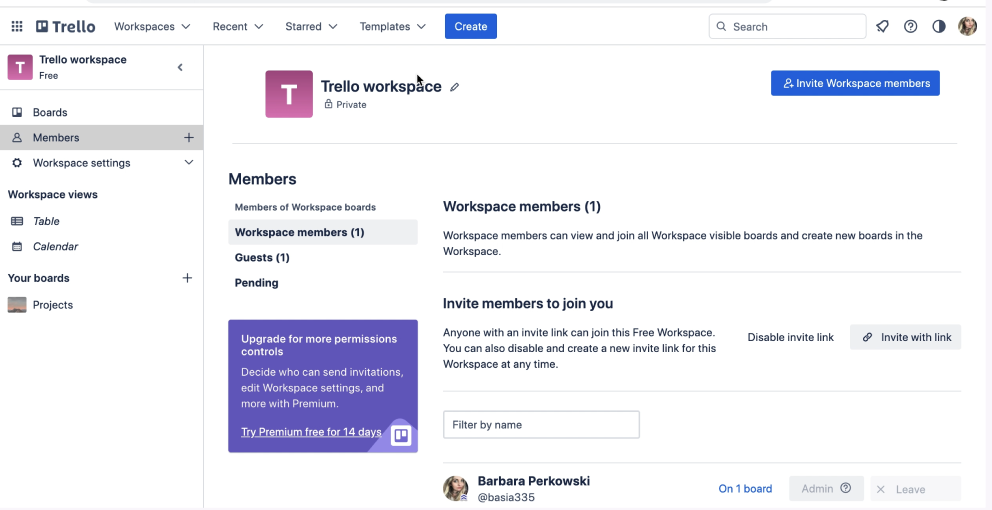
The successful experiment “Workspace shareable link” optimized the sharer’s journey.
Solutions implemented:
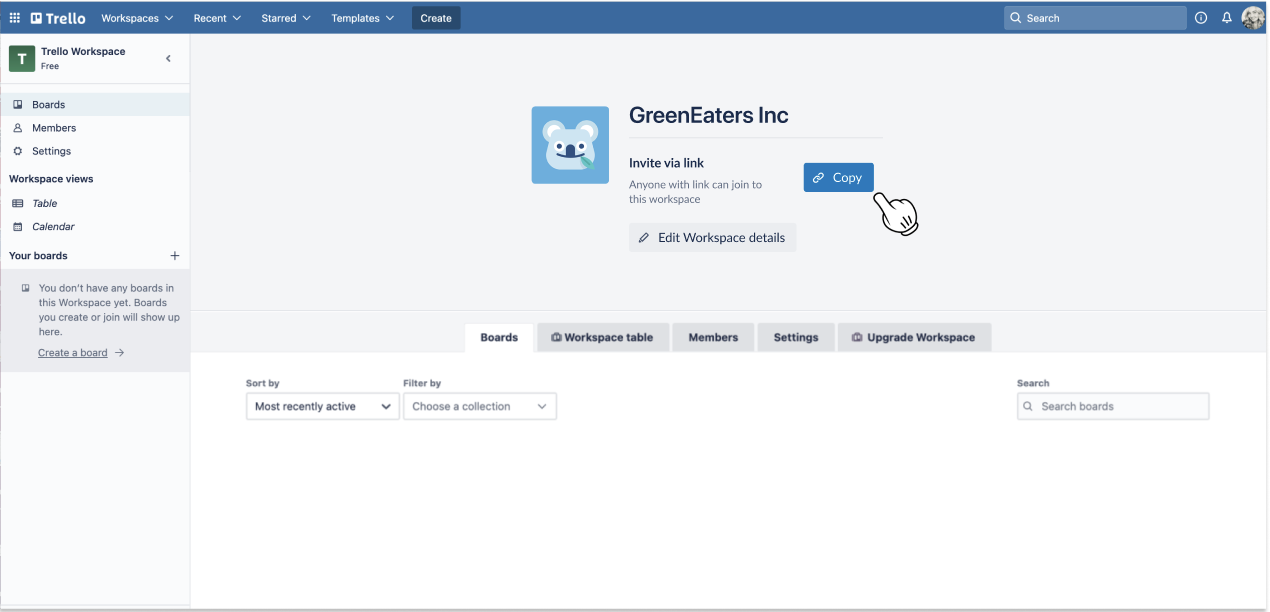
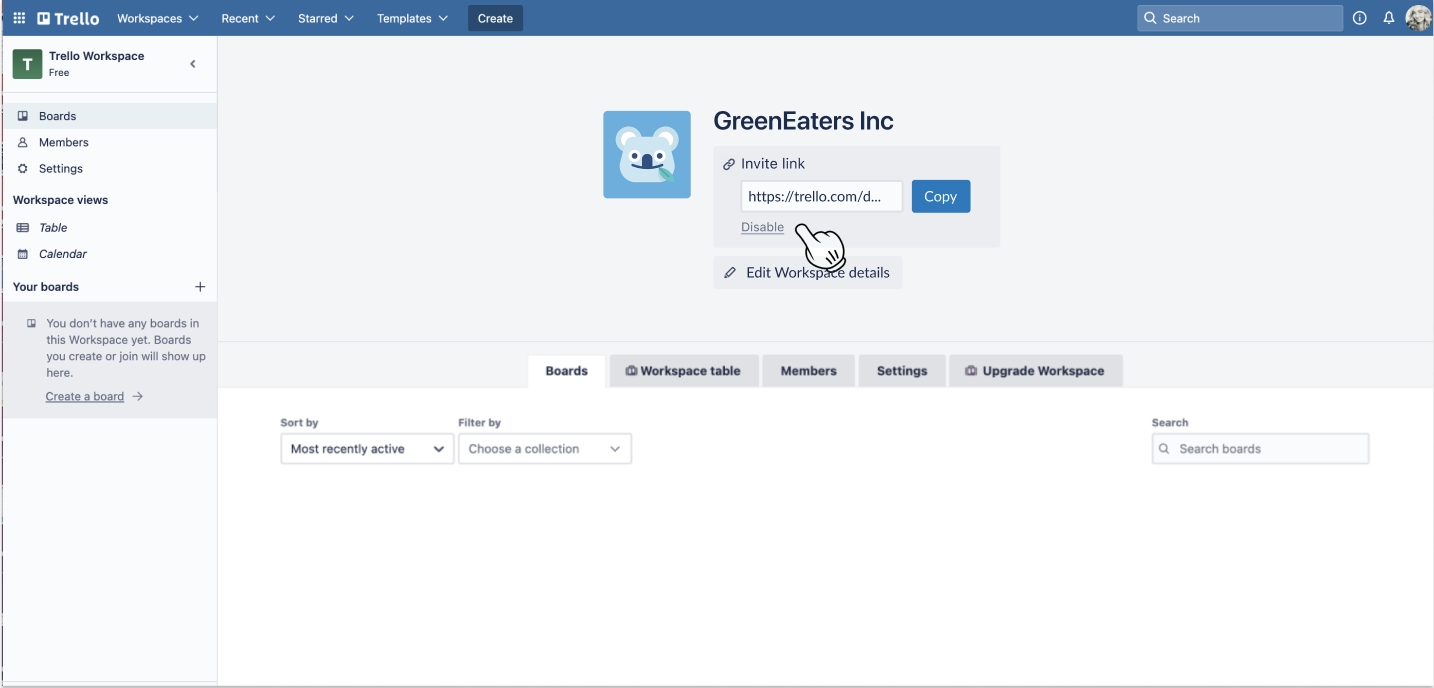
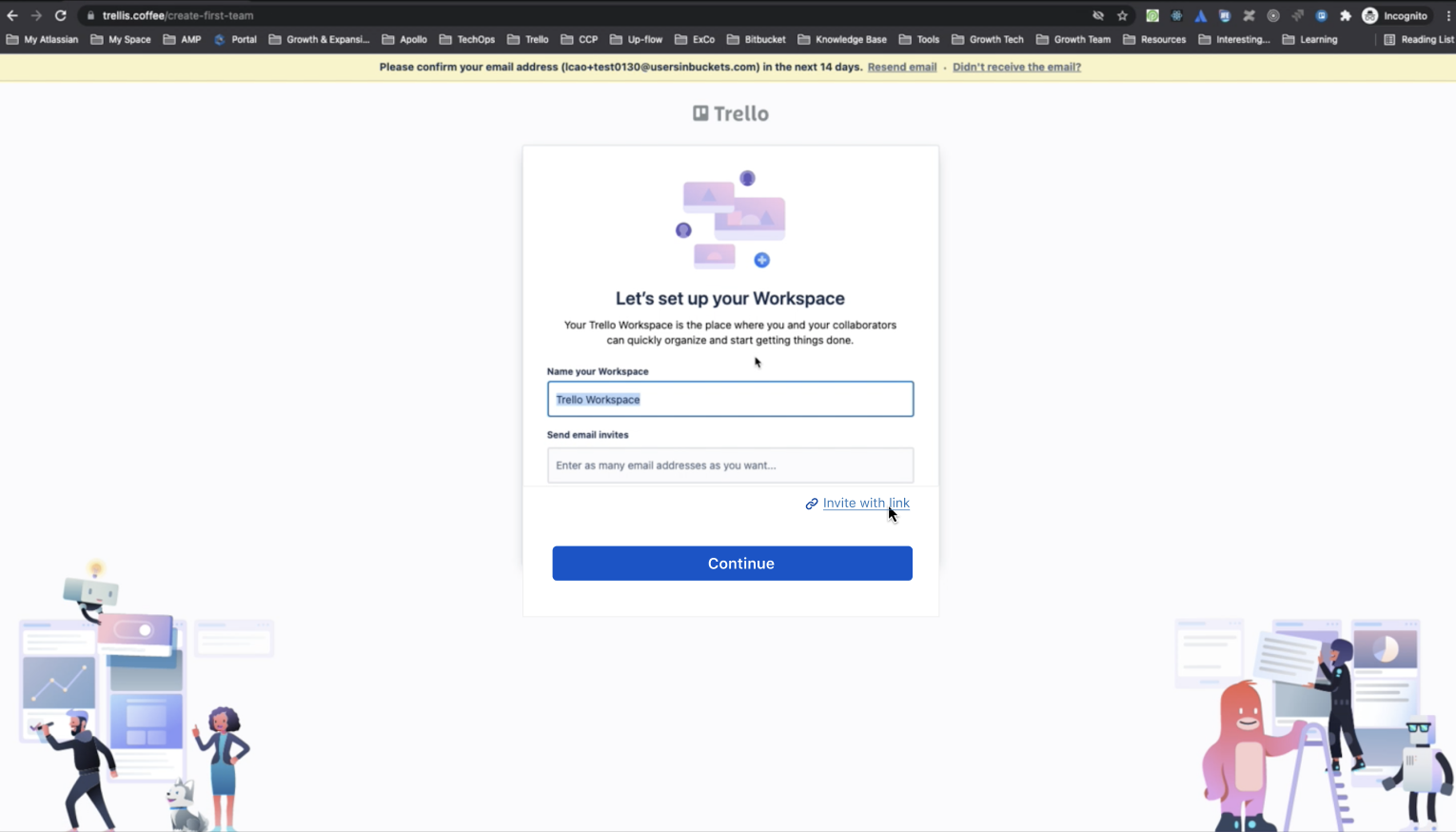
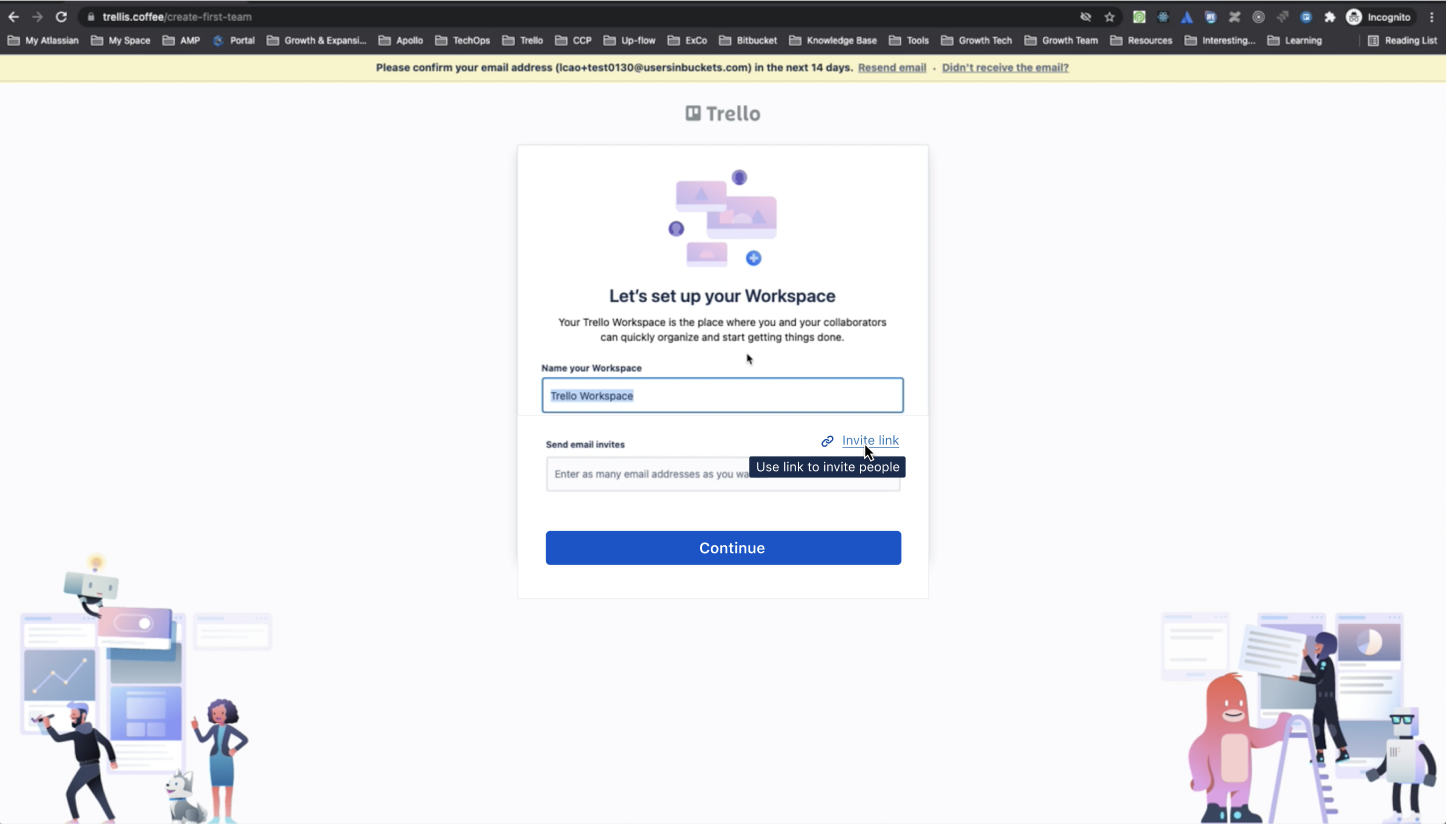
- Designated Workspace section for inviting by link
- Improved workspace creation flow
Business Goals
Why is Trello Virality important?
The business opportunity was to empower team collaboration and encourage more users to use Trello for their collaborative projects by:
- Optimizing collaboration and sharing features by improving the process of creating, sharing, and managing boards, tasks, and teams.
- Effective onboarding by removing complexities and confusion
- Advanced and custom admin tools by improving integration with other platforms
KPIs:
- Increase overall retention and reduce the churn rate
- Increase MAU per each experiment
- Meet OKR at 70K MAU (at least) with a combination of experiments between 4 growth teams
Research
What do we know about Trello customers?

1. Data Analysis
I’ve collaborated closely with the core team and engs to gain a deeper understanding of user behavior of the existing collaboration processes.
Key findings:
Users who invite others to collaborate on Trello engage with the platform twice as much as users who don’t making the invitation process a critical component of user engagement
- The churn rate is increasing and the main reasons are “merging/consolidating” and “competitor”
- Users who were invited to a Trello board have a retention rate of 80% after three months, whereas users who joined independently have a retention rate of 50%
- On average, each user invites 3 other individuals to collaborate on Trello within the first month of their usage
- 30% of new users stop using Trello after their first month. Among those who were invited to a board and started collaborating right away, the churn rate was 20%
- 30% of users experienced a delay in product access
Sharing journey prioritization
Through data brainstorming sessions, the team concluded that optimizing sharing and collaboration features addresses your objectives more directly and has the potential for immediate impact on our key metrics.
By using data-driven insights, the team was able to prioritize focusing on the “invitation to collaborate” journey because of the impact on:
Virality
- Sharers are the primary drivers of product virality. By improving the sharing and collaboration features, you make it easier and more appealing for them to share their boards, which can lead to an increase in new users and, therefore, MAU.
Retention
- If both Sharers and Recipients find the collaboration process in Trello seamless and productive, they’re more likely to continue using the platform for their future projects
Core Functionality
- Sharing and collaboration are the core functionalities of Trello and can lead to a broader overall improvement in user satisfaction and engagement.
2. Desk Research
The problem space was well-known and documented by previous features teams. I’ve analyzed 10 previous research findings done by Trello teams to understand the customer pain points regarding collaboration, sharing, and admin journeys. I led kickoff meetings and brainstorming sessions with the team to share knowledge and understand drop-offs, bottlenecks, and the pain points that were causing barriers to collaboration within Trello.
Key findings:
- Sharing content outside the team is painful
- Delays in product access
- Team silos within the product
- Onboarding is disjointed, unclear, and confusing
- Excessive friction in Trello setup experiences
3. Archetypes and high-level journey
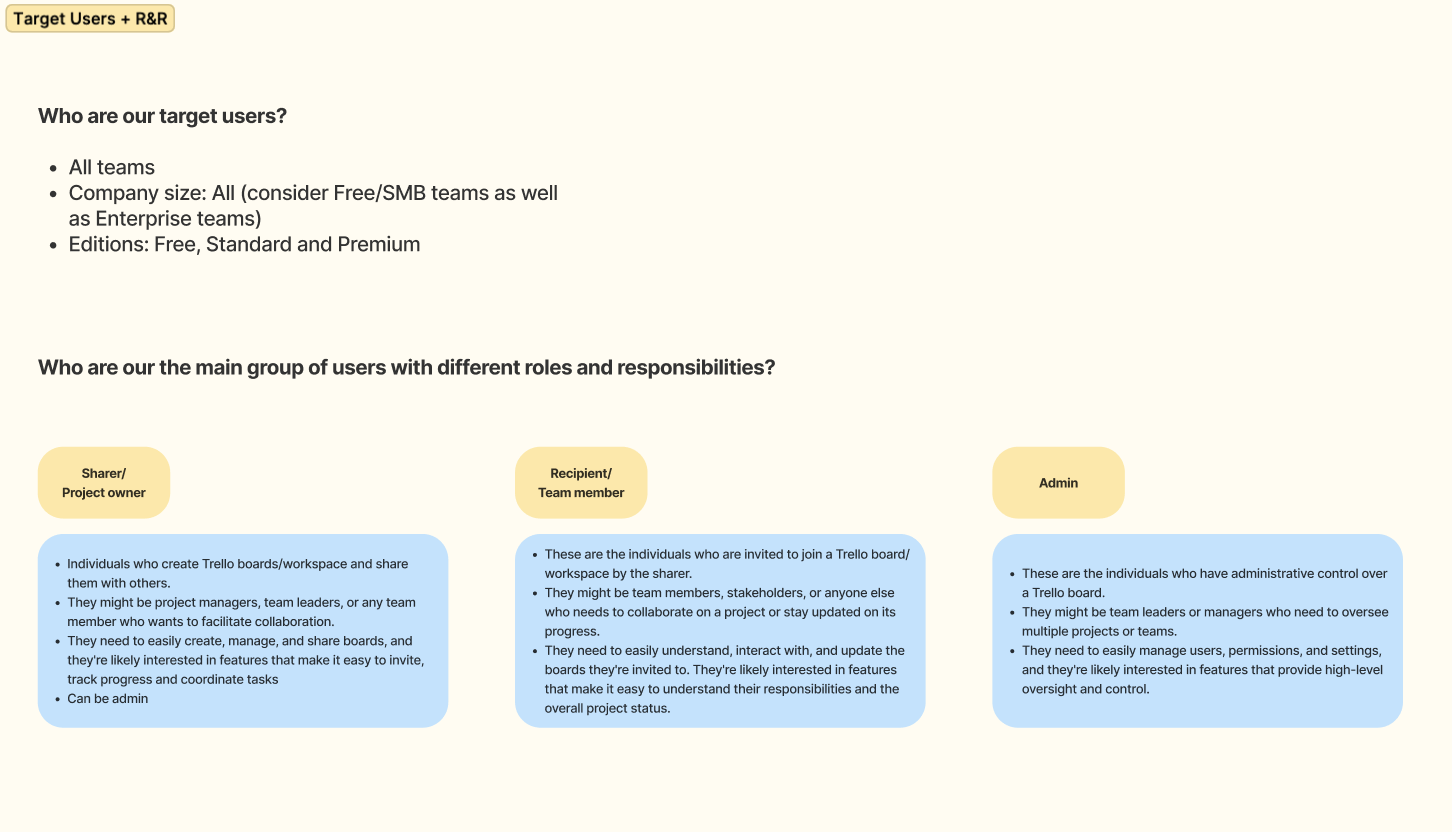
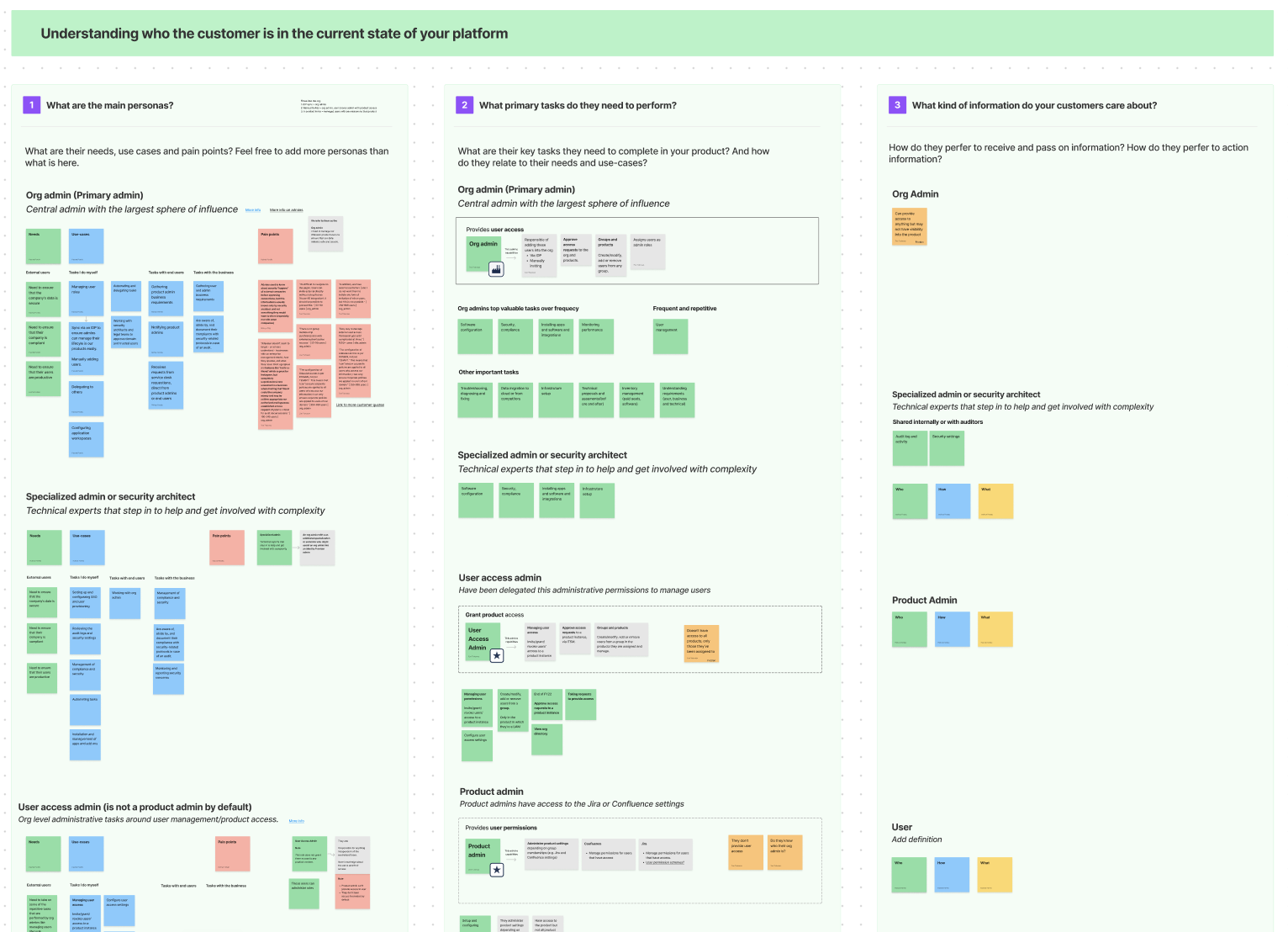
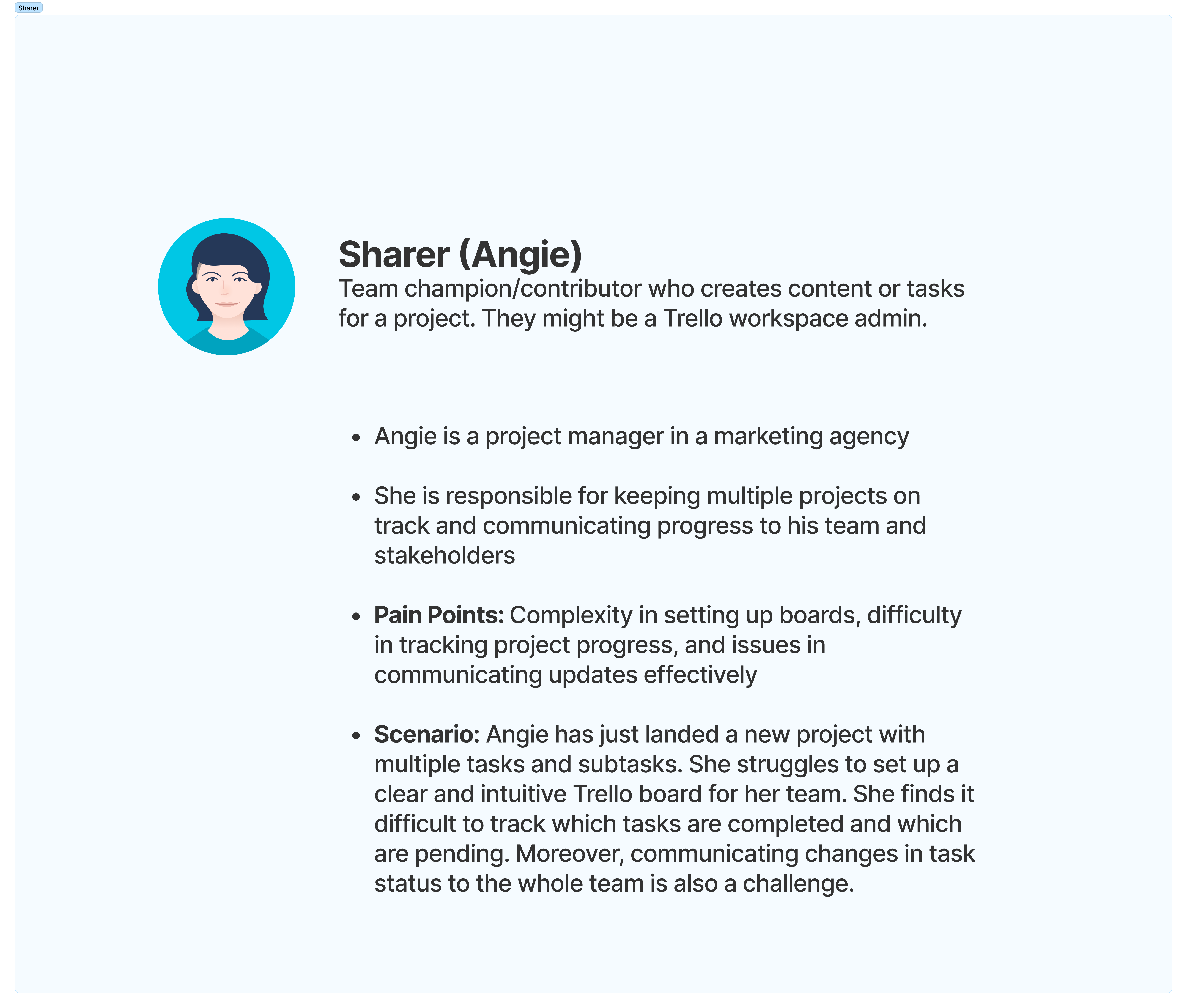
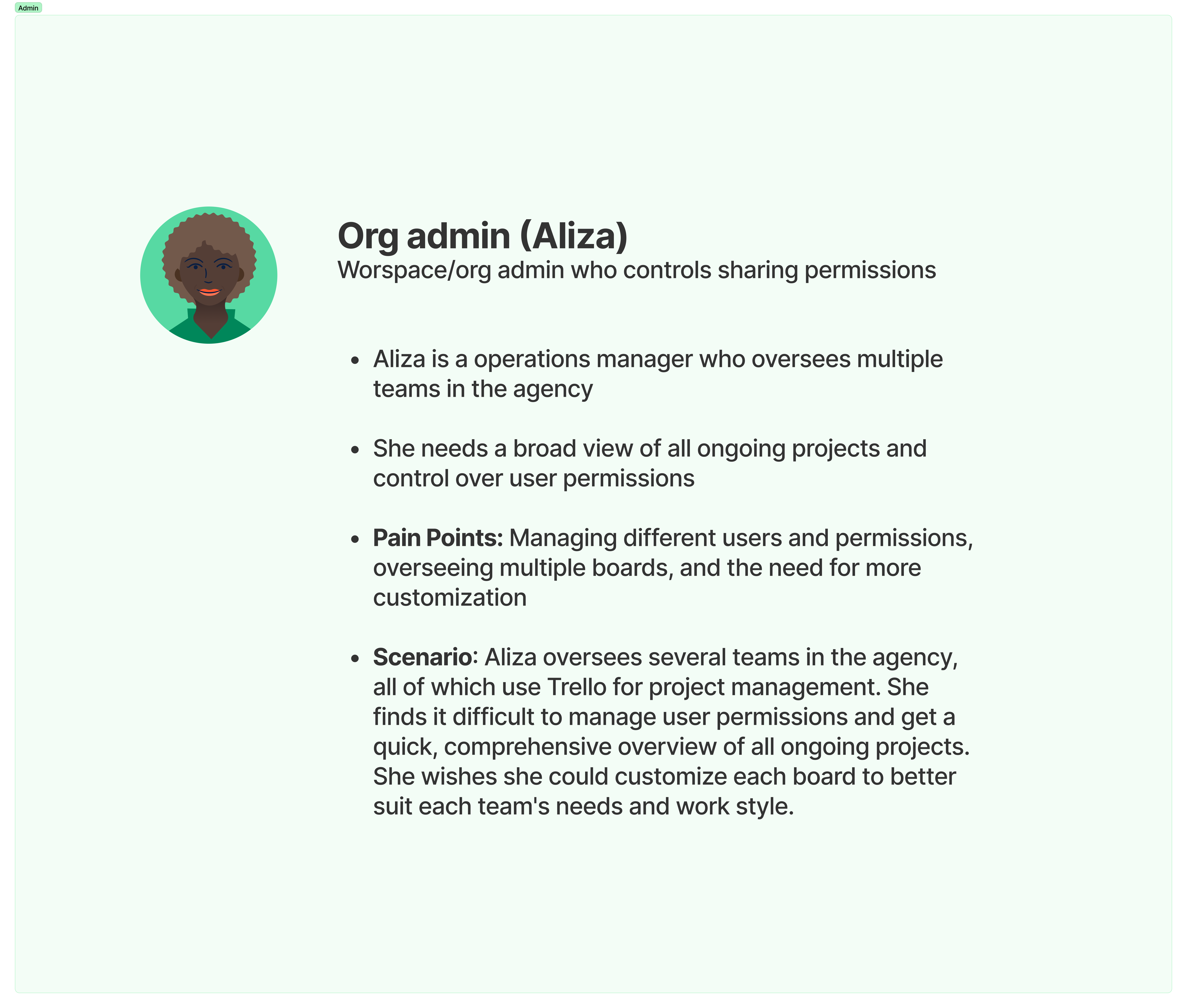
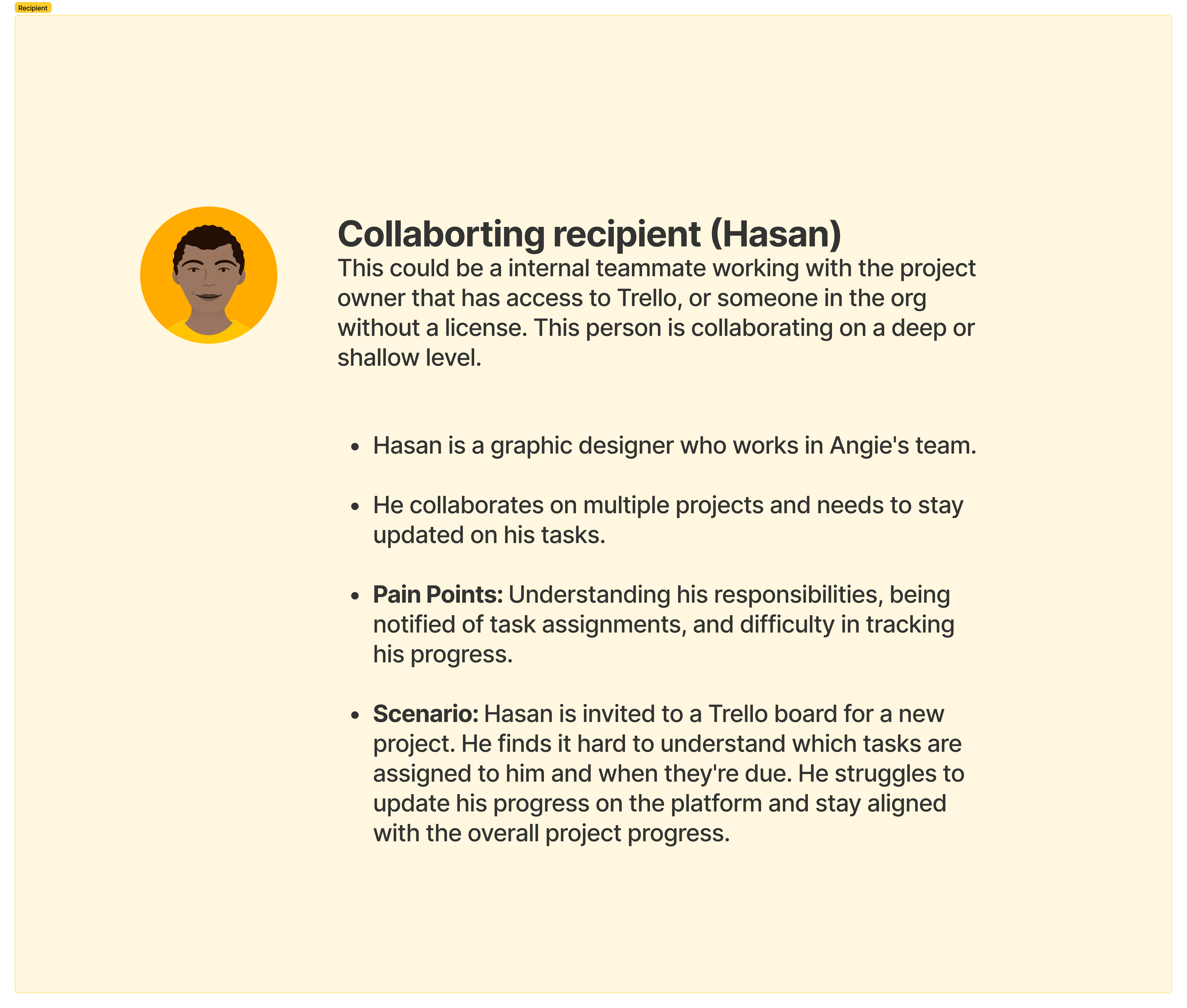
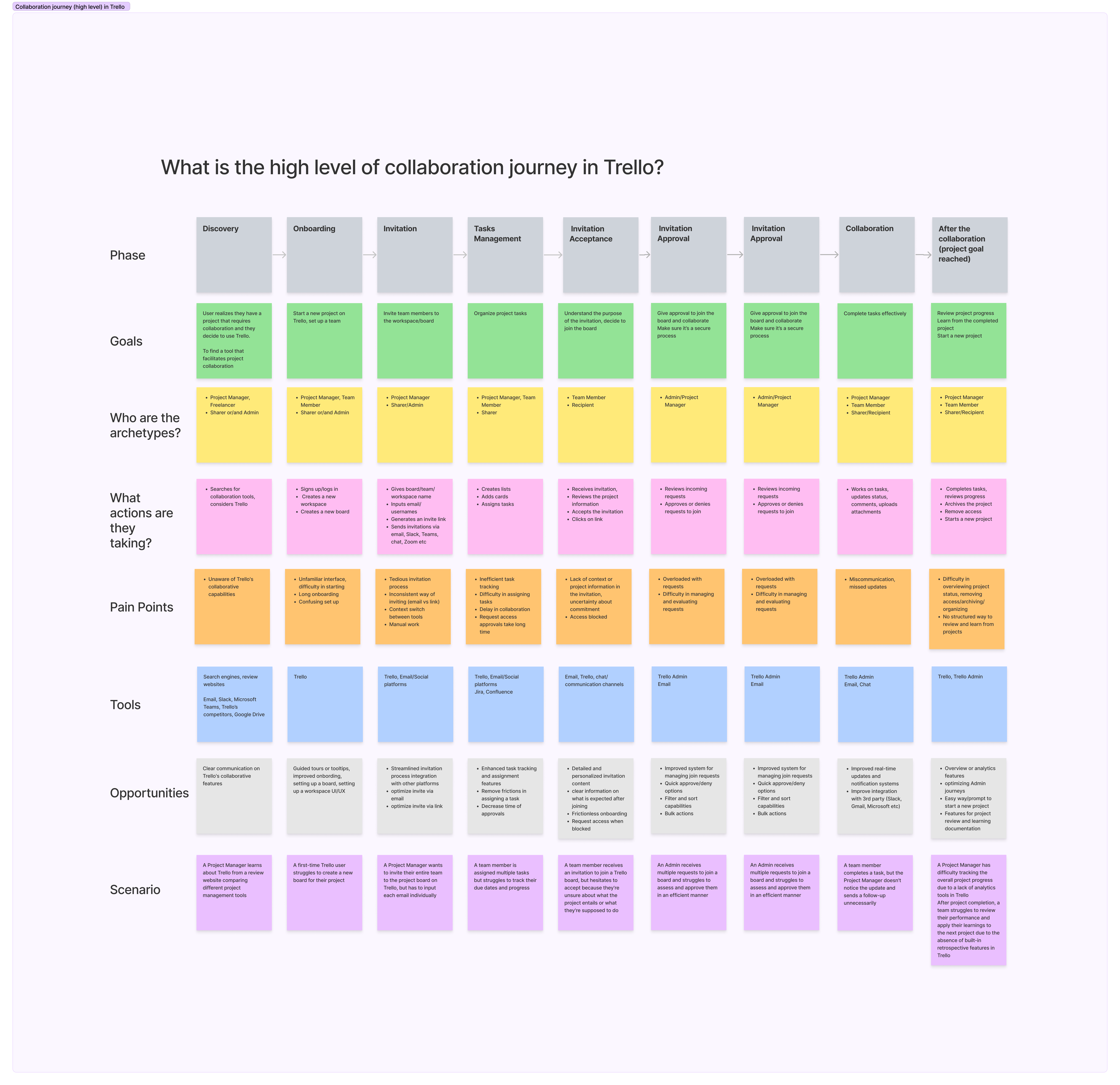
Moreover, I’ve led the team’s personas and customer journey workshops to understand different groups of users involved in the collaboration process, their interactions, pain points, and possible opportunities.
3. Competitive Analysis
I’ve collaborated with my core team and together we have defined Strengths, Weaknesses, Opportunities, and Threats using SWOT analysis.
Opportunities:
- Deep Integration with Email and Collaboration Platforms: There’s significant opportunity for Trello to create deeper, more seamless integrations with popular email platforms and collaboration tools. This could include syncing Trello notifications with Gmail, or creating cards directly from Slack or Microsoft Teams.
Threats:
- Competing Products with Stronger Integrations: Tools like Asana, Slack, and Microsoft Teams offer deep integrations with a variety of other platforms. This offers a more seamless, all-in-one experience that could lure users away from Trello.
- Rising Expectations: As integrations become more common and sophisticated across digital tools, users’ expectations are rising. A lack of meaningful integrations could lead to user dissatisfaction and attrition over time.
Strengths:
- Atlassian Ecosystem: Trello’s strongest integration is with Atlassian’s suite of products. This makes Trello particularly appealing to users already within the Atlassian ecosystem.
- Power-Ups: Trello’s Power-Up feature allows users to add various apps to their boards, enabling some integration with third-party platforms.
Weaknesses:
- Limited Deep Integration: While Trello does offer some level of integration with third-party platforms through Power-Ups, it often lacks deep integration. For example, there’s no direct, built-in functionality for syncing Trello with email platforms like Gmail, or collaboration tools like Slack and Microsoft Teams.
Defining Strategy

The North Star and Trello Virality Objectives
Through collaboration workshops with Trello stakeholders, together we formed objectives with the Trello Virality initiatives:
- Unblock Collaboration: By improving product access, we aimed to facilitate immediate collaboration and eliminate dead ends that could frustrate users and disrupt team synergy.
- Streamline Admin Process: By simplifying the approval process, we could reduce administrative workloads, enabling Trello admins to focus more on their team’s work and less on procedural tasks.
- Drive Growth: Ultimately, our goal was to increase Monthly Active Users (MAUs) and overall growth. We believed that by enhancing the collaborative experience and reducing friction, more teams would be empowered to achieve their potential, thus driving user engagement and growth.
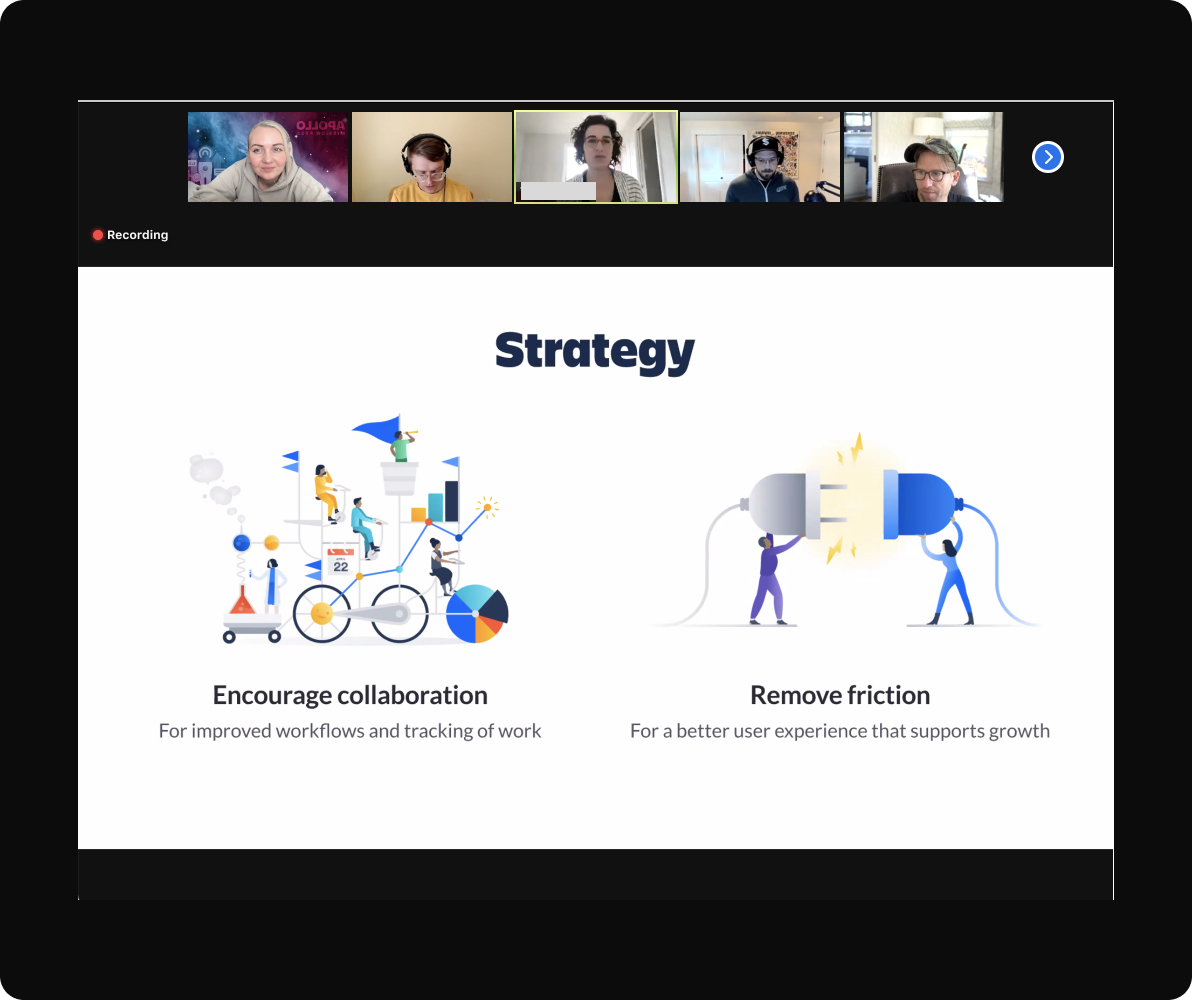
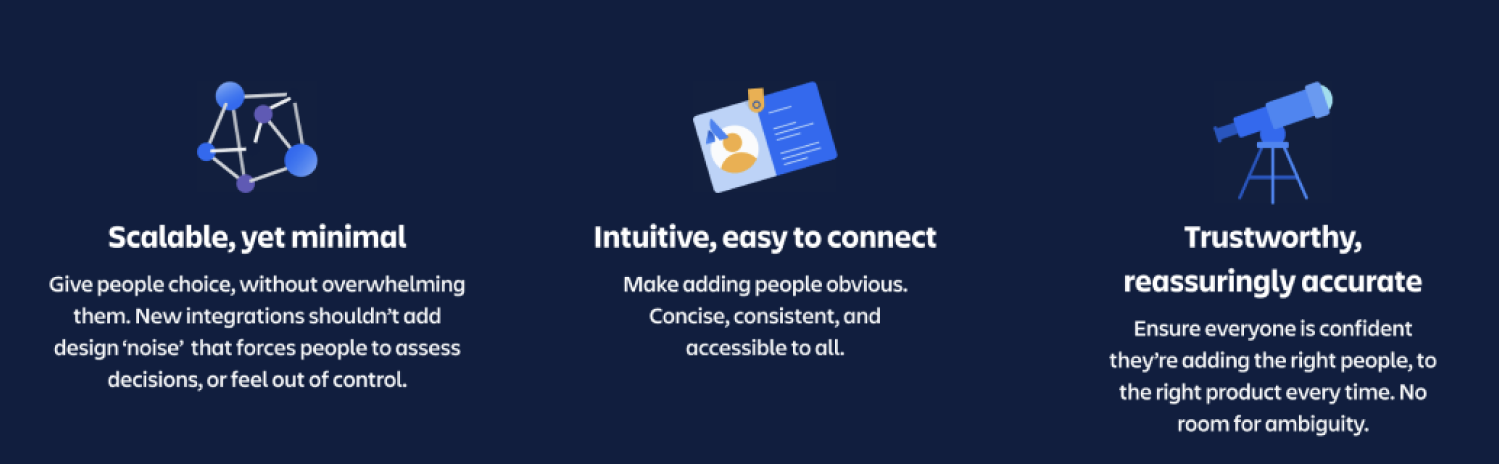
Trello Virality Design Principles
Tactical Strategy
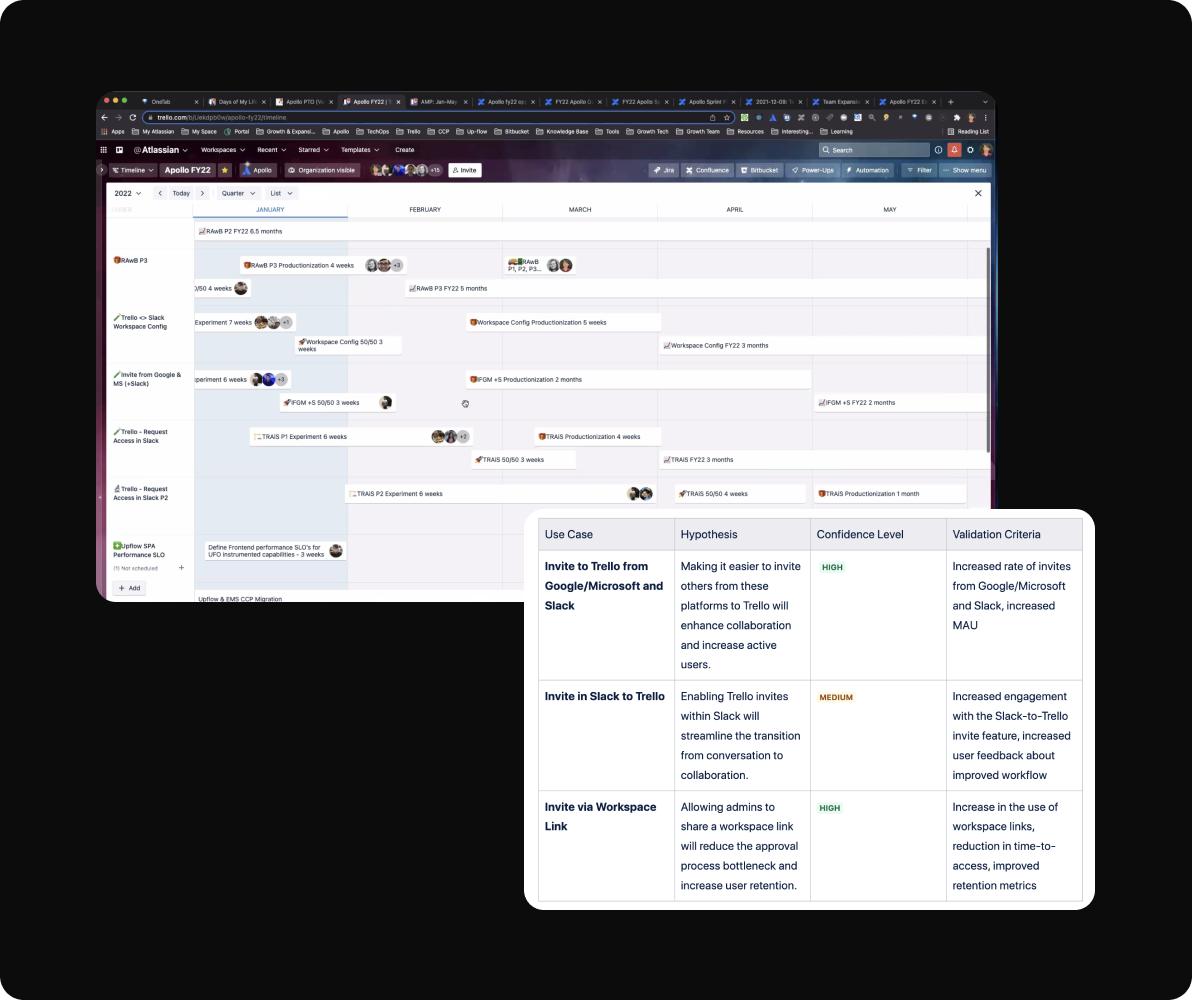
Product roadmap with experiments to prioritize and validate hypothesis
Experiment planning
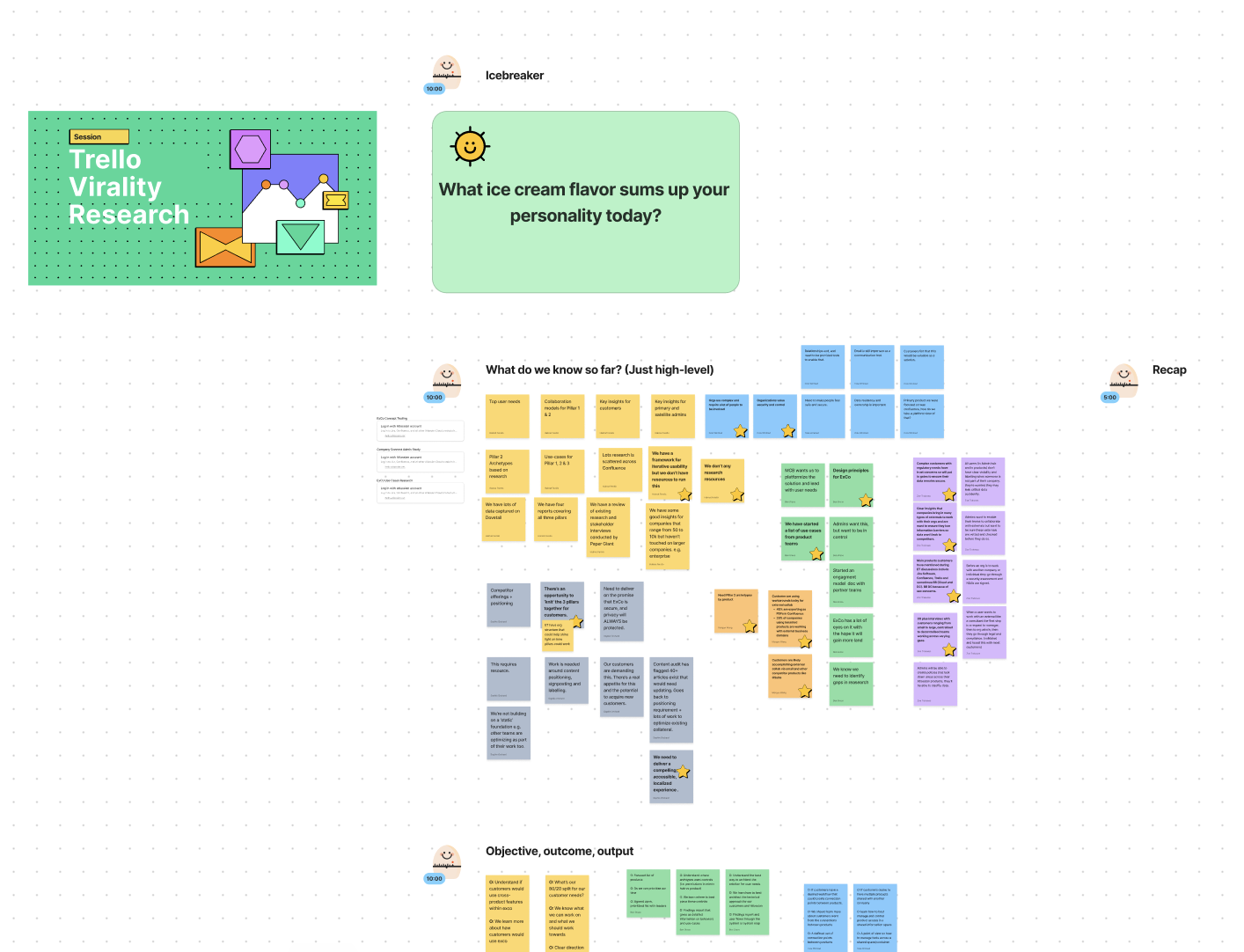
Next, I run ran brainstorming workshops and prioritized opportunities using data insights. In our roadmap, we’ve identified three main use cases as our focus areas, each with a unique hypothesis about how it could drive growth and improve collaboration.
- First, we hypothesized that by simplifying the process of inviting users to Trello from Google, Microsoft, and Slack platforms, we could increase active users by enhancing collaboration. Our confidence in this hypothesis is high, as these platforms are widely used for team communication and collaboration. plus the great success of implementing a similar feature in Confluence.
- Second, we considered the possibility of integrating Trello invites directly within Slack, to make the transition from conversation to collaboration more seamless. Our confidence in this hypothesis is at a medium level because while Slack is a popular team collaboration tool, the effectiveness of this feature would depend on the existing workflows of individual teams.
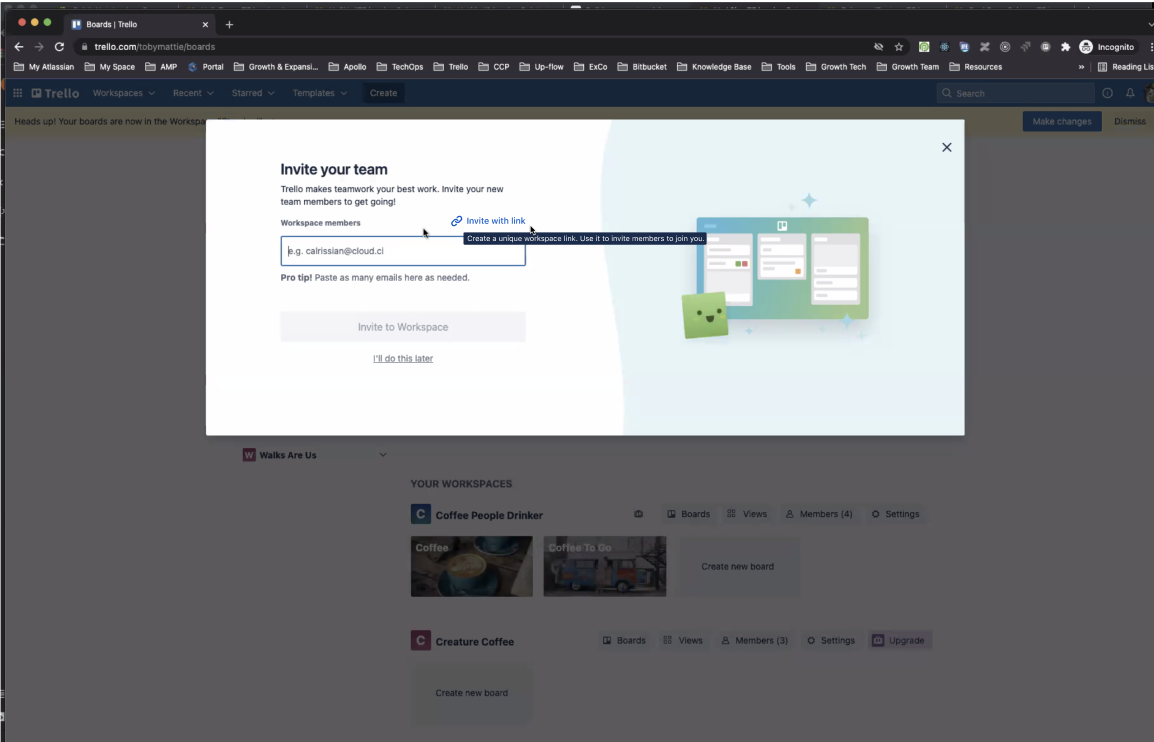
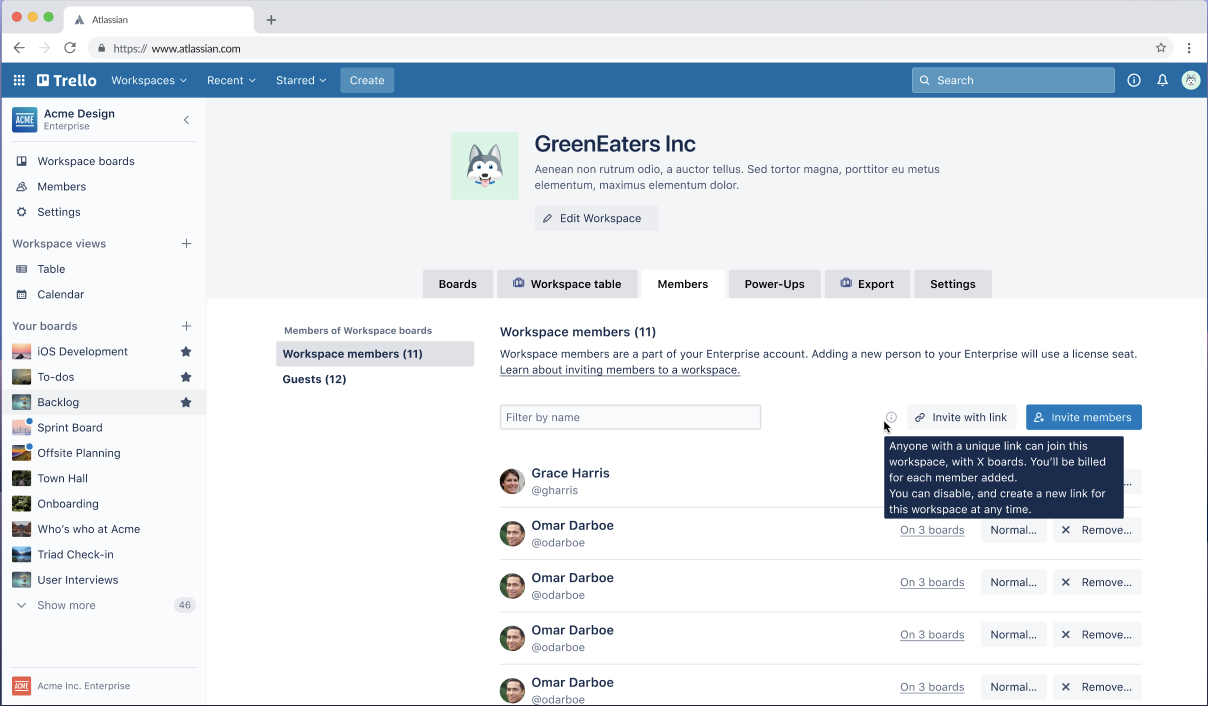
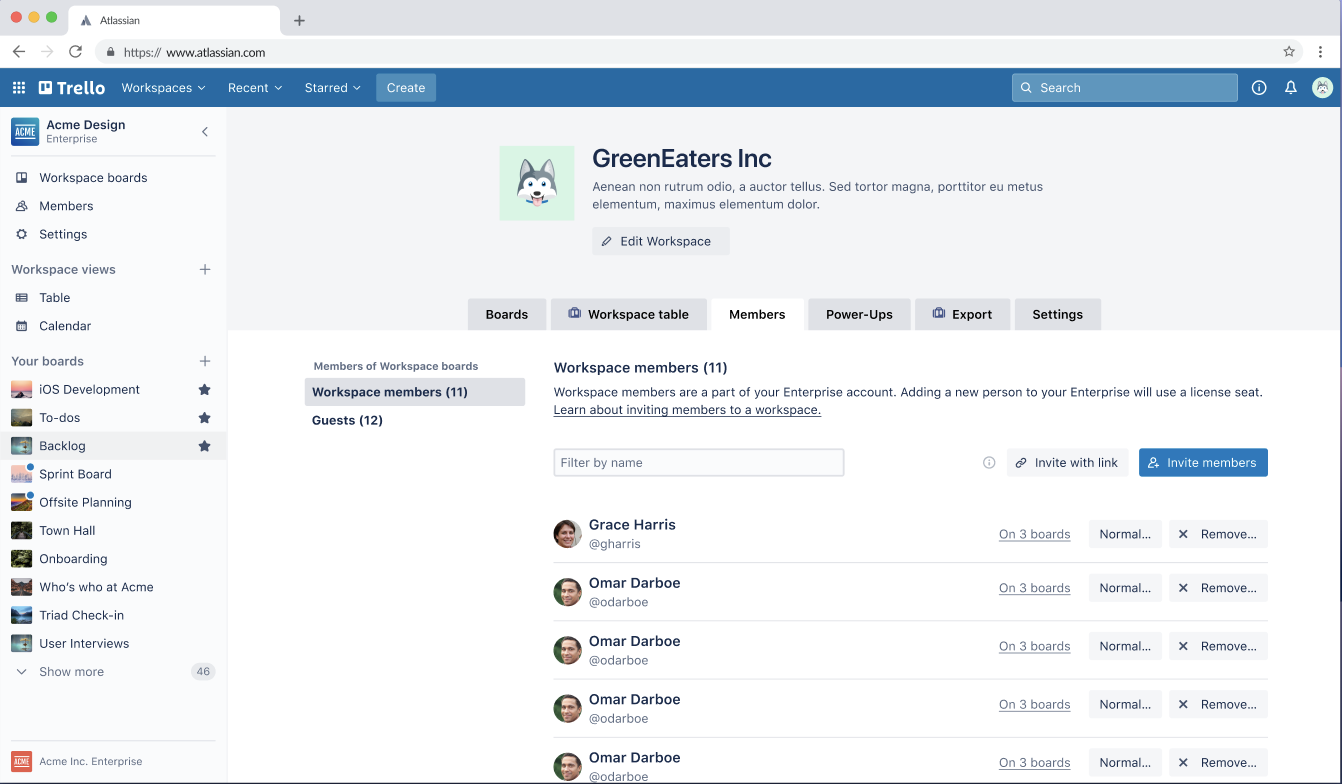
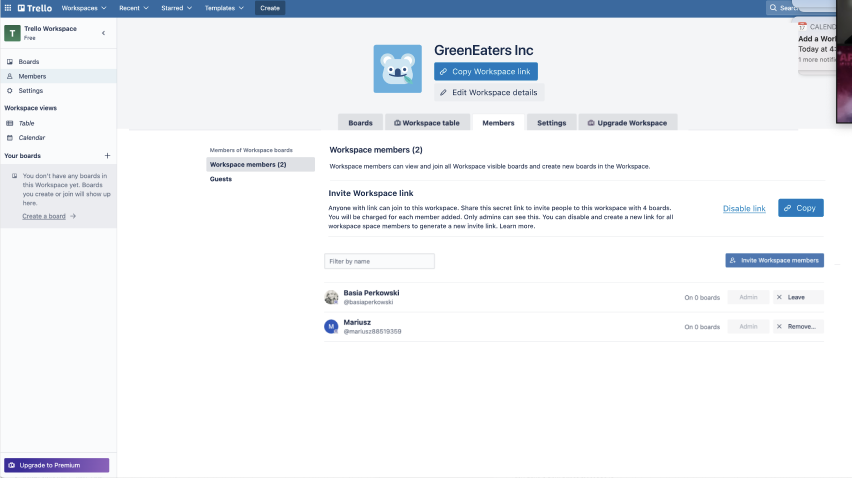
- Lastly, we looked at the potential of inviting with link. We hypothesized that by empowering admins/sharers to share a workspace link, we could reduce bottlenecks and enhance user retention. We had a high degree of confidence in this hypothesis due to the direct impact it could have on the user experience and accessibility.
Q1
Experiment #1, #2 and #3: Invite from Google, Microsoft and Slack
The first experiment was about enabling Trello users to integrate with Google, Microsoft, and Slack to search, so they can find and assign tasks to their teammates regardless of where they are.
As a team, we had high confidence in the hypothesis we had. Our Confluence teams roll out similar experiences very successfully and we assume that Trello will behave similarly.
Hypothesis
We believe that allowing users to search and invite their colleagues from Google/Microsoft/Slack while in Trello will result in an increase of invited users to collaborate because Trello users will be able to quickly and reliably pull the correct teammate who they’re already collaborating within their existing work hub (Gmail, Slack, Microsoft Teams) into Trello. We will know that we are right when we see an increase in MAU and # of new Trello signups
Unfortunately, after 3 weeks of running experiments, we saw no influence on MAU.


Q1
Experiment #1, #2 and #3: Learnings
- Low click-through rate
- Connection rate low
- Only 27% search for their teammates
Why don’t people click on the slack button and what prevents them from finishing the connection flow? Do they understand what they should do after connecting to 3rd party?
I led a follow-up research which revealed:
- Trello has more personal users (Gmail or unknown size) and there is no real need of introducing/integrating with additional platforms (true to small-size companies)
- Privacy concerns and authorization flow may be a blocker
- Usability underlying issues block users from completing the tasks (outside the scope)

Mitigation Plan
Assessments and Decisions
- First 3 experiments weren’t moving a needle
- Leadership is concerned about reaching 0.7 (70K MAU) OKR
- Backlog review and pivot to Workspace link while uncovering new pain points
The first four experiments offered useful insights, but they didn’t yield significant results warranting full-scale implementation.
However, data showed potential in the Workspace link experiment. Users were hitting bottlenecks in the approval process, slowing collaboration, and potentially affecting retention. We saw that by optimizing Workspace Link Sharing, we could streamline collaboration and improve retention.
As a team, we made the strategic decision to prioritize the Workspace Link Sharing experiment over other Backlog items.
Q2
Inviting with a link to Trello Workspace Experiment (deep dive)

Wonder phase: Research
Users usually take a long journey to copy workspace link
I ran the qualitative and quantitative user research phases by analyzing existing reports and data funnels. Additionally, I did a competitive analysis on inviting by link journey to identify best practices.
Key findings:
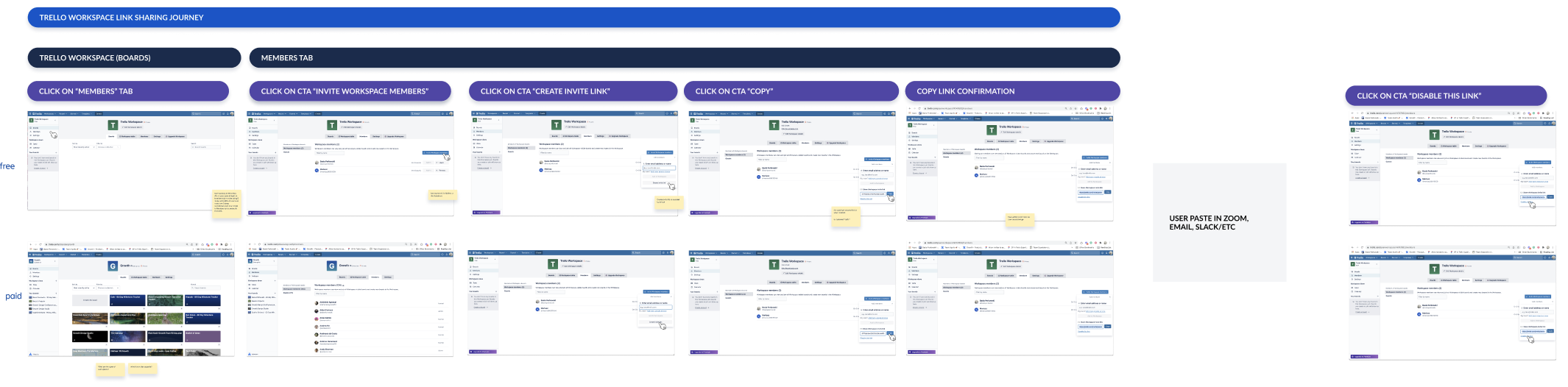
- For user who starts from the workspace home screen, it took them 23 steps to copy workspace links on average.
- 19% of admins are super motivated to invite
- Security concerns, inviting is not a common task
- Link auto-generation is the best practice
- The link URL was hidden all the time
- Confirmation flags are expected


Mapping out the current experience
Problem Statement
Next, I’ve defined our problem statement and hypothesis.
HOW MIGHT WE…
How might we make sharing a workspace link more visible, discoverable, and findable?
How might we make users feel confident their worskpaces are secured and not being shared?
HYPOTHESIS
We believe that allowing Trello users to share Trello Workspace quickly links upon sign-up and workspace creation.
This will increase the number of invitees per link shared and higher MAU
Because of the friction of discoverability, findability, and only manual input are removed. Users will feel more confident in sharing a secured, assured link.
We will know this to be true when there is a decreased time on task and a number of steps when sharing a link compared to before the experiment.


Target Users
For this experiment, we wanted to target Trello users who are able to invite other users to their Trello workspaces and have a clear intent to use Trello collaboratively.
This included:
– All users in the free/standard plans
– Users in the paid plans are based on the workspace settings


Opportunity Analysis
If the user can’t find something, it doesn’t exist for them. Making sharable workspace links more discoverable and findable increases the chances users will encounter, use them more often, and invite more members. It would remove some friction, potentially unlocking a much larger number of people using our tools and collaborating quicker within workspaces.
If each link gets 1.5 incremental users copying the links, we can bring ~2000 new MAU to Atlassian.
Design Concepts
I facilitated ideation sessions with the core team and engs to generate ideas and solutions.
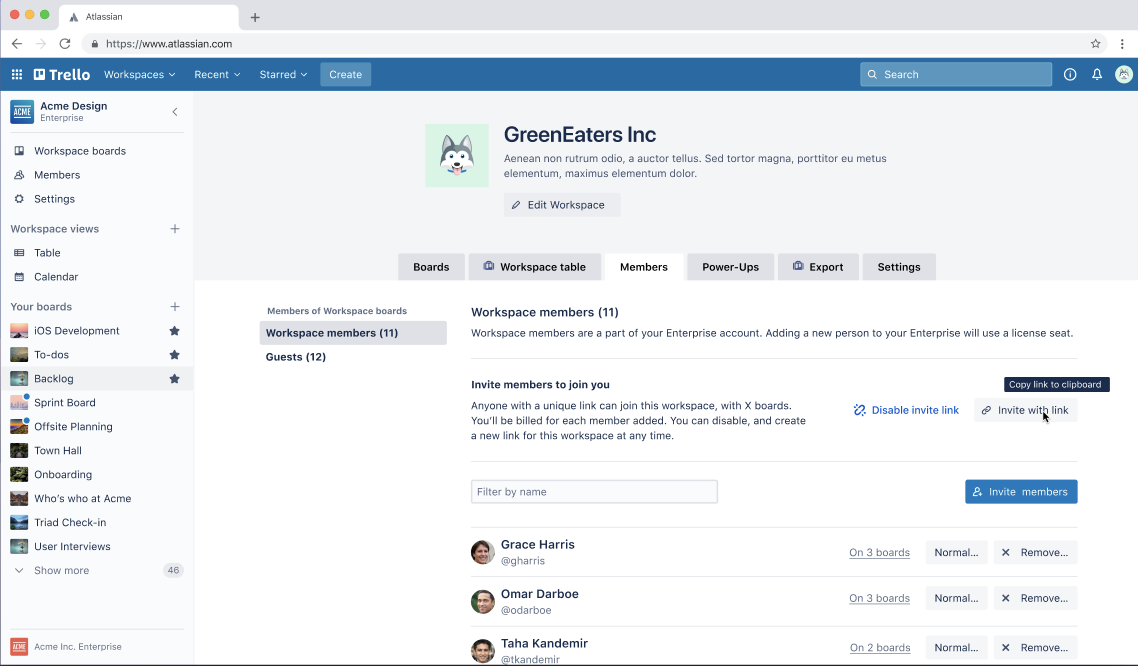
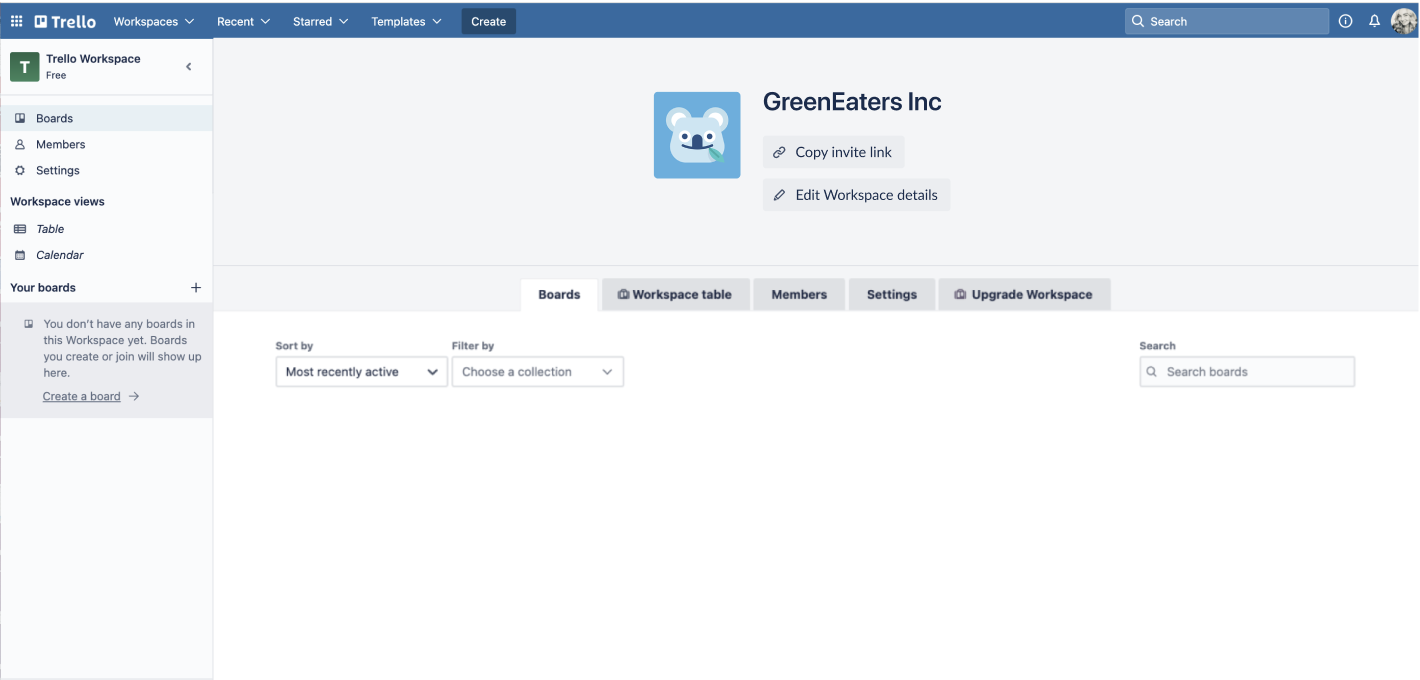
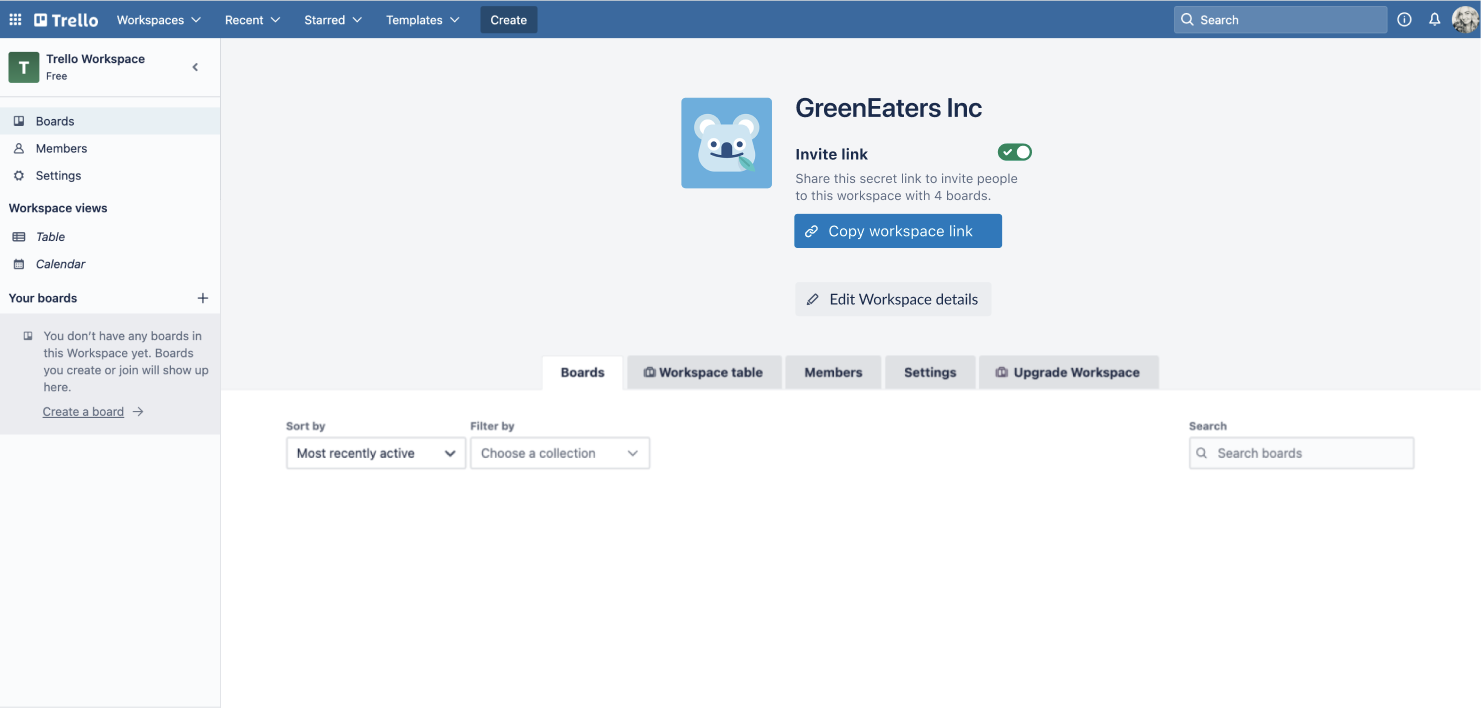
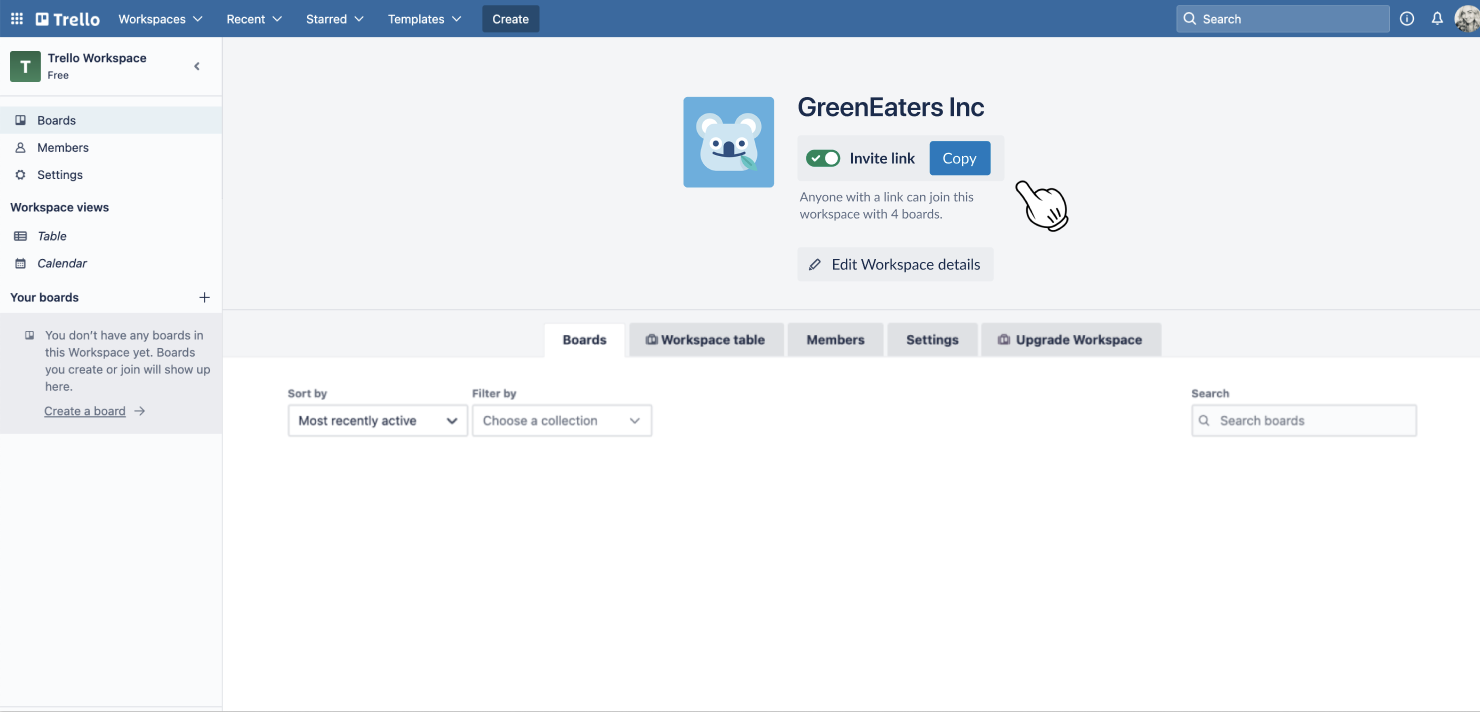
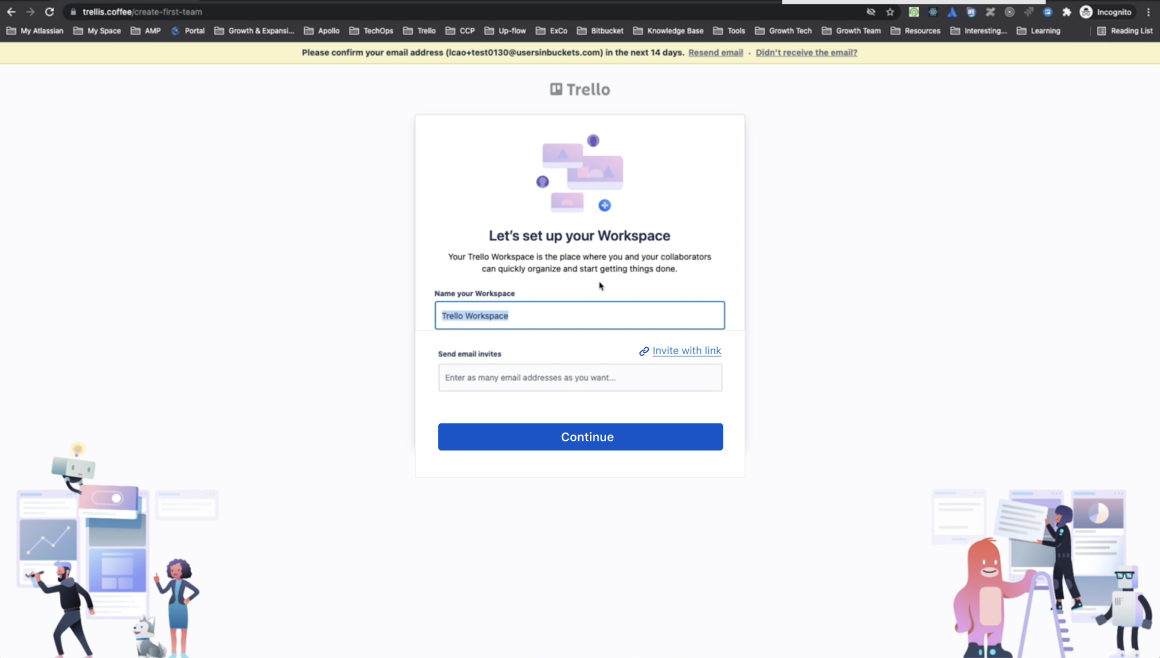
Design Critiques
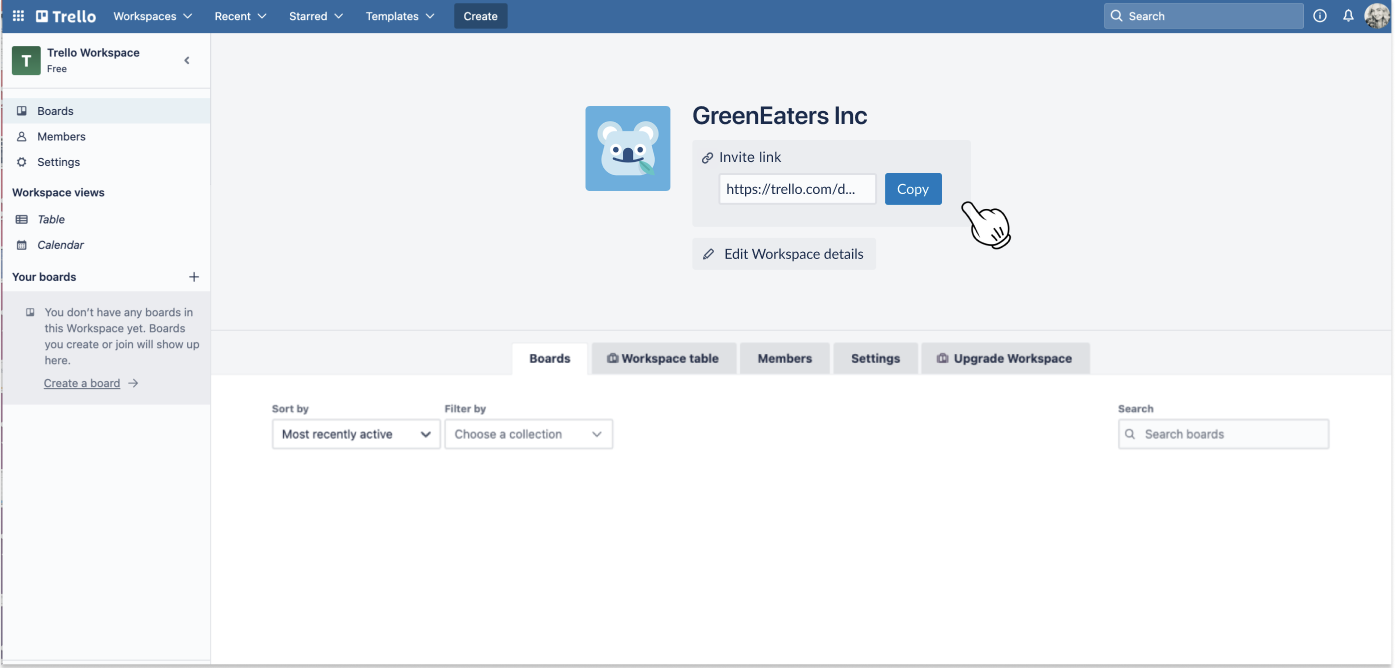
I led multiple design critiques (live and async) with the core team, engs, Trello’s stakeholders, Trello’s design teams, and Growth design teams. Iterated on feedback, helped refine the scope, and aligned on user goals.
During one of the meetings, we discovered that the Trello Design team was in the middle of redesigning their onboarding experience and they were about to ship an MVP of the new designs. As a team, we decided to remove the onboarding touchpoint from our experiment and run it as a separate experiment in the future, to avoid convoluting data and wasting engineer effort, if productized.
QA Support and Edge cases

Final Designs
Results are in!
After 3 weeks of running the experiment, we got the initial data: MAU increased by 2,9K, which helped to reach 0.7 OKR for the Apollo Team 🥳
We saw a +77% increase in copy links. The majority of copy link rates were coming from new and optimized entry points compared to prior.
On the other note, we also saw a +134% increase in the link disabled rate which we considered as a healthy measure of user awareness and security.
The team decided to productionized an experiment and address translation and accessibility as the next step.


Learnings
- Having a growth mindset is contagious and important when things do go not as planned
- Competing goals may impact the scope and it’s important to understand other teams’ priorities
- Involve the Content Designer early in the process, so the content strategy is planned as a long-term goal

Check yourself how to invite with a link in Trello!
Sign up for a free account and start collaborating 🙂